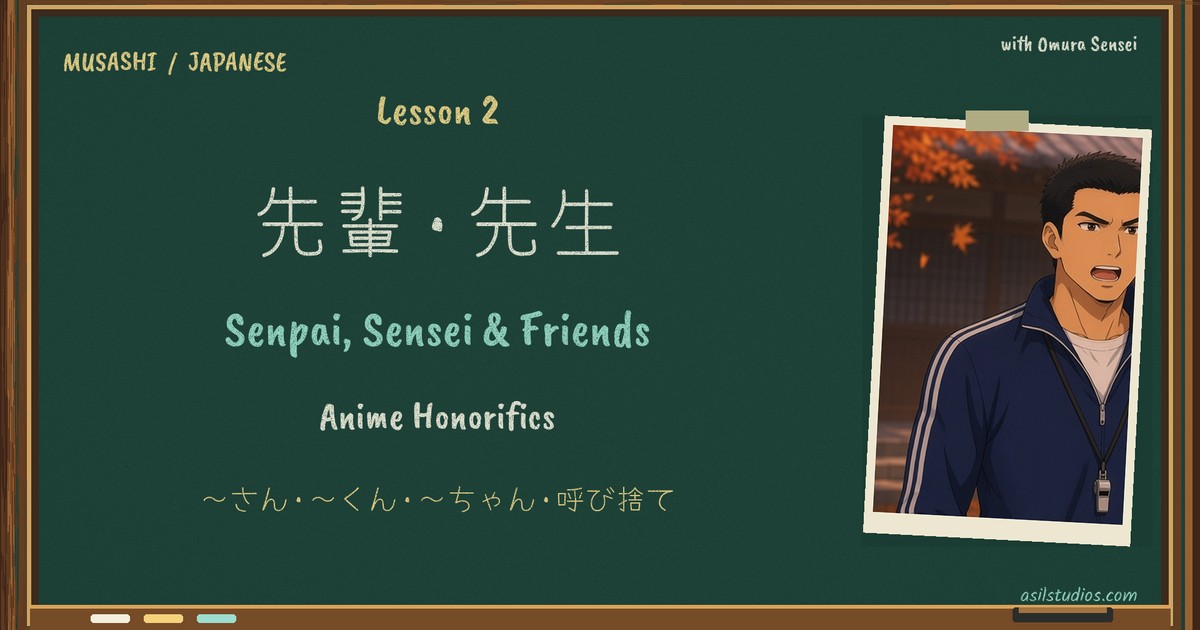
In anime school life, the little tag after a name can open a door—or close one. Lesson 2 of Omura Sensei’s Musashi Japanese series teaches the honorifics Koji, Taku, and their classmates actually use: the safe default -san, sensei for teachers, senpai for upperclassmen, -kun and -chan among friends, and when closeness lets the tags drop entirely.
Watch the full chalkboard lesson below, then keep the phrase notes, mini hallway scene, and quick quiz handy for practice.
~さん — -San
Meaning: Mr. / Ms. / polite name tag (the safe default).
When to use: Almost anyone you don’t know well yet—a new classmate, a club neighbor, someone whose name you just learned. When unsure in Musashi (or real life), choose -san.
Polite vs casual: Friendly and polite without sounding stiff. You can get more casual later; you can’t always unsay a too-casual tag.
Example: たけしさん、こんにちは。 / Takeshi-san, konnichiwa. — Hello, Takeshi.
Tip from Omura: 迷ったら、「さん」です。 / Mayottara, “san” desu. — When you’re unsure, use -san.
先生 — Sensei
Meaning: Teacher / instructor / mentor (also doctors and masters).
When to use: The adult who teaches you—classroom teachers, coaches, mentors. Often after the family name: Omura-sensei. Or just Sensei when you’re talking straight to them.
Polite vs casual: Don’t slap -san on your teacher. Sensei carries respect and a little warmth. For these teen lessons, think school first.
Examples: 大村先生! / Ōmura-sensei! — Omura Sensei!
先生、おはようございます。 / Sensei, ohayō gozaimasu. — Good morning, Sensei.
先輩 — Senpai
Meaning: Upperclassman / senior (school or club).
When to use: Someone ahead of you—older grade, longer on the team, further along the path. Satō-senpai, or just Senpai when it’s clear who you mean.
Polite vs casual: Respectful and school-casual—perfect for club hallways. In Musashi we keep it friendly and club-focused, not romance-coded.
Example: 佐藤先輩、よろしくお願いします! / Satō-senpai, yoroshiku onegaishimasu! — Satō-senpai—please treat me kindly!
~くん — -Kun
Meaning: Friendly / familiar school tag (often boys; teachers→students; guys among friends).
When to use: Teachers calling male students (Nakamura-kun), or friends who are comfortable with each other. Warmer than -san, still polite enough for school.
Polite vs casual: Think “friendly school tag,” not a joke. If you’re not sure, -san is still safer.
Examples: 中村くん、いるかな? / Nakamura-kun, iru kana? — Nakamura-kun, are you here?
こうじくん、放課後どうする? / Kōji-kun, hōkago dō suru? — Kōji-kun, what are you doing after school?
~ちゃん — -Chan
Meaning: Soft / affectionate / cute-familiar tag (friends, kids, close nicknames).
When to use: Close friends and cute nicknames. Keep it kind and buddy-level for Musashi teens—not flirty.
Polite vs casual: Never use -chan with your teacher. Omura-chan? Absolute no. Respect first. Cute second.
Example: みかちゃん、待って! / Mika-chan, matte! — Mika-chan, wait up!
呼び捨て — Yobisute (first name only)
Meaning: Calling someone by name with no honorific—usually trust and closeness.
When to use: Close friends who are fine with it. Koji and Taku might start with Nakamura-kun, then one day it’s just Kōji! and Taku!
Rule for teens: Don’t drop someone’s honorific unless you’re sure they’re okay with it. Closeness is offered, not grabbed. When unsure, keep -san.
Examples: Early — 中村くん、行こう。 / Nakamura-kun, ikō. — Nakamura-kun, let’s go.
Later — こうじ、待って! / Kōji, matte! — Kōji, wait!
Mini hallway scene
Listen for sensei with the teacher, senpai with the upperclassman, -kun in attendance, a soft -chan between close friends—and first names only once trust is there.
| Speaker | Japanese | Romaji | English |
|---|---|---|---|
| Taku → Omura | 先生、こんにちは。 | Sensei, konnichiwa. | Hello, Sensei. |
| Koji → Senpai | 先輩、今日も練習ですか? | Senpai, kyō mo renshū desu ka? | Senpai, practice today too? |
| Omura | 中村くん、たくくん。 | Nakamura-kun, Taku-kun. | Nakamura-kun. Taku-kun. |
| Friend | みかちゃん! | Mika-chan! | Mika-chan! |
| Taku → Koji | こうじ、走ろう! | Kōji, hashirō! | Kōji, let’s run! |
| Koji | おう、たく! | Ō, Taku! | Yeah, Taku! |
Quick quiz
Pause if you need a second. Answers are at the bottom of this section.
- What’s the safest name tag when you’re not sure? A) -chan B) -san C) first name only
- What do you call a club upperclassman? A) Sensei B) Senpai C) -chan
- When is first-name-only usually okay? A) Day one with a teacher B) With close friends who are fine with it C) With every stranger
Answers: 1-B ~さん (-san) · 2-B 先輩 (Senpai) · 3-B 呼び捨て with close friends who are fine with it
Keep exploring Musashi
More from Asil Studios: the Musashi project, Meet the Characters, and the rest of the Japanese Lessons series. Watch on YouTube @AsilStudios.
What’s next
Pick one honorific and say a name with it out loud—just once. Muscle memory loves repetition. Lesson 3 will cover how anime characters say “I”: watashi, boku, and ore—the self-intro pronouns that change how a character sounds on day one.
If this helped, subscribe on YouTube so you catch the next lesson when it lands. Mata ne!