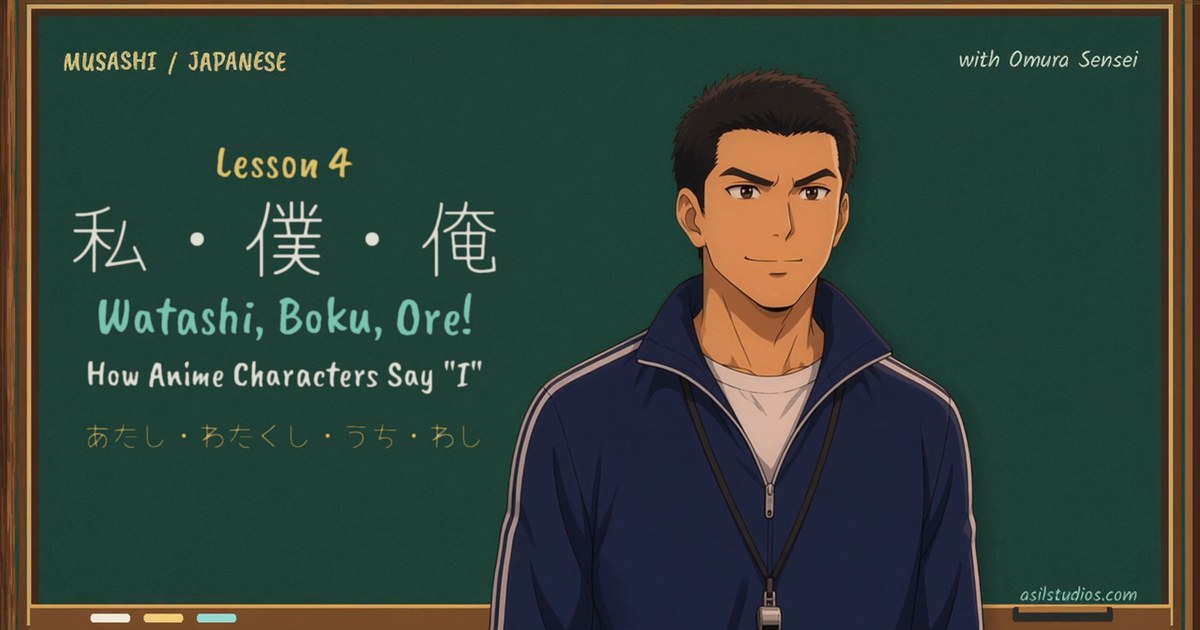
In anime, Taku says ore, Koji says boku, and Omura Sensei says watashi, and every one of them means “I.” In English, I is just I. In Japanese, the word you pick for yourself tells everyone who you are before you even finish the sentence. Lesson 4 of Omura Sensei’s Musashi Japanese series teaches the anime words for “I”: watashi, boku, and ore, plus the bonus words atashi, watakushi, uchi, and the famous anime grandpa word, washi.
Watch the full chalkboard lesson below, then keep the pronoun notes, mini scene, and quick quiz handy for practice.
私 — Watashi meaning: the safe, standard “I”
Meaning: I. The safe, standard choice.
Who uses it: Anyone: boys, girls, adults, teachers. In a job interview, a speech, or talking to someone you just met, watashi is always correct.
Polite vs casual: For women and girls, watashi is also the everyday word. For men and boys, it sounds polite and a little formal. So when a tough anime hero suddenly says watashi, pay attention: he’s being careful, or he’s wearing his work face.
Examples: 私は大村です。 / Watashi wa Ōmura desu. — I’m Omura.
私はたくの母です。 / Watashi wa Taku no haha desu. — I’m Taku’s mother. (Mrs. Saito)
Tip from Omura: When in doubt, say watashi. You’ll never be wrong.
僕 — Boku meaning: the friendly, gentle “I”
Meaning: I, mostly used by boys and young men.
Vibe: Friendly, gentle, and a little polite. Think of the kind, bookish kid in an anime, or a boy talking to his teacher. Koji uses boku with Omura Sensei: respectful, but not stiff.
Polite vs casual: Boku is softer than ore and more relaxed than watashi. Some grown men keep boku their whole lives, and it makes them sound warm and approachable. One catch: in a formal job interview, even boku is a little casual. That’s watashi’s job.
Examples: 僕は中村こうじです。 / Boku wa Nakamura Kōji desu. — I’m Koji Nakamura.
先生、僕がやります! / Sensei, boku ga yarimasu! — Sensei, I’ll do it!
俺 — Ore meaning: the casual, confident “I”
Meaning: I. Casual, confident, and very masculine.
Vibe: The word of the hot-blooded hero, the rival, and pretty much every shonen main character yelling his dream at the sky. Taku uses ore with his friends. It says, “I’m relaxed, I’m one of the guys.”
Rule: Ore is for friends and family, not for teachers or bosses. If Taku says ore to Omura Sensei, he’d better be ready for extra laps. The twist: Koji uses ore too, but only with Taku.
Examples: 俺はたく! / Ore wa Taku! — I’m Taku!
俺、腹へった! / Ore, hara hetta! — I’m starving!
俺も! / Ore mo! — Me too!
あたし / わたくし / うち — Atashi, Watakushi, Uchi (bonus words for “I”)
あたし / Atashi: A casual, softer form of watashi, used mostly by girls and women. In anime it can sound cute, or bold and sassy. Grandma Kobayashi uses atashi, and trust Omura, it is not cute.
わたくし / Watakushi: The extra-formal “I”: speeches, business apologies, and the elegant rich girl who laughs behind her hand.
うち / Uchi: In western Japan, especially around Osaka, many girls say uchi for “I.” Hear uchi, and that character is probably from Kansai.
Examples: あたしに任せな! / Atashi ni makase na! — Leave it to me! (Grandma Kobayashi)
わたくし、大村と申します。 / Watakushi, Ōmura to mōshimasu. — I am Omura. (very formal)
わし — Washi: why anime grandpas say it
Meaning: I, the anime grandpa word.
Who uses it: Old men in anime, the wise master and the grumpy grandpa, often say washi. Some real older men in western Japan say it too, but in anime it’s practically a costume. Grandpa Kobayashi uses it about his ramen, of course.
Example: わしのラーメンは日本一じゃ! / Washi no rāmen wa Nippon-ichi ja! — My ramen is the best in Japan!
The big idea: In anime, the word for “I” is a character design choice, just like hair color or a jacket. Writers pick it to tell you, in one little word, who this person is.
Switching and dropping “I” (Ganbarimasu!)
Real people switch: Koji says boku to his teacher, ore to Taku, and watashi in a formal speech. Switching isn’t fake. It’s just reading the room, like how you talk differently to your grandma and your best friend.
Dropping “I”: Japanese speakers often skip “I” completely. If it’s obvious who’s talking, you just drop it. Instead of 僕はがんばります / Boku wa ganbarimasu, Koji just says:
Example: がんばります! / Ganbarimasu! — I’ll do my best!
Mini anime scene
Listen for which “I” Koji picks with his teacher, and what happens when Taku catches him.
| Speaker | Japanese | Romaji | English |
|---|---|---|---|
| Omura Sensei | 中村くん、だれがやる? | Nakamura-kun, dare ga yaru? | Nakamura-kun, who’ll do it? |
| Koji | 僕がやります! | Boku ga yarimasu! | I’ll do it! |
| Taku | お前、「僕」だって! | Omae, “boku” datte! | Ha! You said “boku”! |
| Koji | 先生の前だから! | Sensei no mae da kara! | Sensei was right there! |
Anime “I” recap
| Japanese | Romaji | Who / vibe |
|---|---|---|
| 私 | Watashi | Safe & standard, for everyone |
| 僕 | Boku | Friendly, gentle (boys) |
| 俺 | Ore | Casual & confident, friends only |
| あたし | Atashi | Casual & soft, mostly girls and women |
| わたくし | Watakushi | Extra formal |
| うち | Uchi | Kansai girls |
| わし | Washi | The anime grandpa |
Remember: real speakers switch with the situation, and often drop “I” altogether. In Musashi, every character’s “I” tells you who they are.
Quick quiz
Pause if you need a second. Answers are at the bottom of this section.
- Taku is joking around with his friends. Which word for “I” fits him best? A) watakushi B) ore C) atashi
- You’re giving a speech at a school ceremony. What’s the safe choice? A) ore B) uchi C) watashi
- Which word is the classic anime grandpa? A) washi B) boku C) atashi
Answers: 1-B 俺 (Ore) · 2-C 私 (Watashi) · 3-A わし (Washi)
Watashi, boku, ore FAQ
What is the difference between watashi, boku, and ore?
All three mean “I.” Watashi is the safe, standard word anyone can use. Boku is a friendly, gentle “I” used mostly by boys and young men. Ore is casual and confident, for friends and family, not teachers or bosses.
Can girls say boku or ore?
In anime, a girl using boku or ore is usually a deliberate character choice to make her sound boyish or tough, and girls will sometimes say boku in pop songs. In everyday conversation, though, girls and women don’t use it—they stick to watashi, or the casual atashi.
Why do anime grandpas say washi?
Washi is the classic anime old-man word for “I.” Some real older men in western Japan use it, but in anime it works almost like a costume for wise masters and grumpy grandpas.
Do Japanese people always say “I”?
No. If it’s obvious who is talking, Japanese speakers often drop “I” completely, so “Ganbarimasu!” alone means “I’ll do my best!”
Keep exploring Musashi
More from Asil Studios: the Musashi project, Meet the Characters, and the rest of the Japanese Lessons series. Watch on YouTube @AsilStudios.
What’s next
Homework: next time you watch anime, listen for the word each character uses for “I,” and ask yourself why the writer picked it. Then tell us in the YouTube comments which “I” you would use if you were in Musashi.
More lessons are on the way. Find every lesson so far on the Japanese Lessons page, and subscribe on YouTube so you catch the next one when it lands. Mata ne!
← Lesson 3: Tadaima! Coming Home in Anime Japanese — Doorway Words · Lesson 2: Senpai, Sensei & Friends — Anime Honorifics